Most organizations are surprised by how familiar this feels.
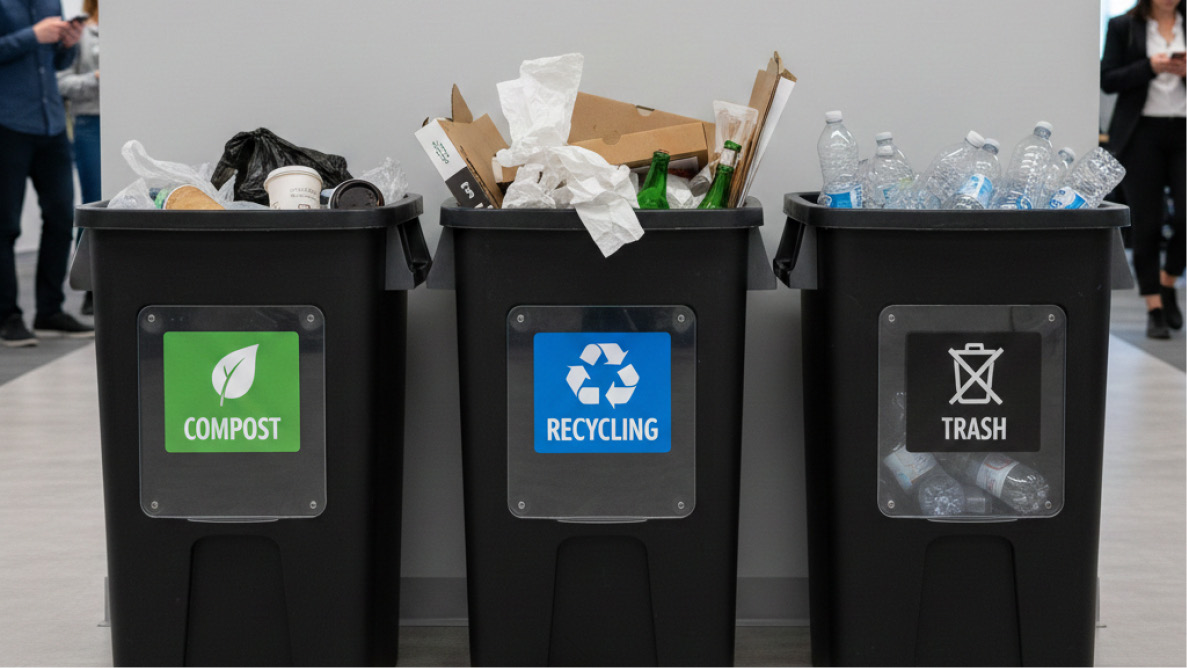
You put the right bins in place. You label them clearly. You invest time in training and communication. For a while, it looks like things are moving in the right direction. Then a few months pass, an audit happens, or someone takes a closer look, and the same problems are still there. Contamination hasn’t really gone away. Participation varies wildly depending on the location or the day. The results aren’t terrible, but they aren’t improving either.
That pattern is far more common than people like to admit.
The reason usually has very little to do with motivation, and almost everything to do with how the system is designed.
Why this keeps happening
Most waste programs are built on a reasonable assumption: if people know what to do, they’ll do it. Labels exist to make that knowledge visible. Training exists to reinforce it. Together, they’re meant to carry the system forward.
And for a while, they do.
Early improvements tend to be real because attention is high. The program is new. People are thinking about it. They’re slowing down just enough to notice the signage and make different choices. But routines have a way of reasserting themselves, especially in shared spaces where waste decisions happen quickly and without much thought.
Once attention fades, the system quietly shifts into a different mode, one where it relies on people remembering detailed rules in low-attention moments and applying them perfectly, every time, across hundreds or thousands of small decisions. That’s a fragile place for any system to live.
What labeled bins are actually good at
Labels do something important. They communicate intent.
They tell people how the system is supposed to work and what the organization cares about. They set expectations and create a common reference point. Without them, nothing else really works.
But labels are static. They don’t respond to behavior, and they don’t adapt when reality doesn’t match intent. Over time, they blend into the background, especially in busy environments where people are focused on getting to their next meeting, finishing a shift, or just moving on with their day.
When something goes wrong, the label doesn’t notice. The system doesn’t notice either.
Why progress slows down instead of continuing
As time passes, most programs start to rely more heavily on audits, spot checks, or informal observation to understand what’s happening. Those tools can be helpful, but they’re limited by nature. They capture moments, not patterns.
Without a continuous way to see outcomes, it becomes hard to answer basic questions. Which items are causing the most confusion? Which locations struggle the most? Is the problem getting better, worse, or just moving around?
When those answers aren’t clear, organizations tend to respond by trying harder. More reminders go out. Training sessions become more frequent. Champions are asked to intervene. None of that is irrational, but it increases effort without increasing insight, which is why it rarely produces lasting change.
This is the point where programs often stall.
It’s not a people problem
It’s easy to assume that behavior hasn’t changed because people don’t care enough or aren’t paying attention. In reality, most stalled programs are already operating in organizations where people genuinely want to do the right thing.
What’s missing isn’t concern. It’s feedback.
When a system can’t show what’s actually happening, it can’t learn. And when it can’t learn, it can’t improve, no matter how much effort you put into it. Over time, that creates frustration on both sides. Leaders feel like they’re pushing without traction, and employees feel like they’re being asked to try harder without clear guidance on what’s actually going wrong.
That’s a design issue, not a motivation failure.
What usually happens next
At this stage, many organizations double down on what they already know. They add more signage. They refine training materials. They audit more often. Sometimes those steps help in the short term, but they also increase the amount of manual work required to keep the system afloat.
The underlying structure doesn’t change, which means the same issues tend to resurface.
Programs start moving again when the focus shifts away from reminders and toward visibility, when the system itself is able to surface insight instead of relying on periodic check-ins and best guesses.
What actually changes outcomes
Sustainable improvement usually begins once organizations can see what’s truly entering each waste stream, not just what’s intended to go there. That visibility makes it possible to spot patterns, identify repeat problem items, and reinforce education based on real behavior rather than assumptions.
Once feedback improves, behavior follows more naturally, because the system is finally responding to reality instead of hoping people compensate for its blind spots.
Where this fits in the bigger picture
This pattern almost always shows up after a program is established. The infrastructure exists. The intent is there. What’s missing is a way for the system to learn from itself.
Many organizations reach this point without realizing it has a name. It’s often described as a program that’s stalled, but the more accurate description is a system that lacks feedback.
Recognizing that distinction is what makes it possible to move forward again.
If this feels familiar
If you’re seeing this dynamic in your own organization, the next useful question isn’t whether the program should exist. It’s whether the system is designed to observe what’s actually happening day to day.
A short diagnostic can help clarify whether the challenge is limited visibility, a stalled feedback loop, or something more structural. If you want to explore that, the simplest place to start is by taking a closer look at what’s really going into your waste streams.