Most teams can point to a moment when contamination dropped. Sometimes it was after a new bin rollout. Sometimes after a training. Sometimes after an audit, a reminder email, or a reset that finally seemed to work.
For a while, the numbers looked better. Loads were cleaner. Complaints slowed down. There was a sense that the problem had been addressed.
Then, gradually, contamination returned.
Not all at once. Not dramatically. Just enough to be frustrating. Enough to make people wonder whether the effort was worth it, or whether they were back where they started.
This pattern is so common that it’s almost the rule rather than the exception. And it usually has very little to do with people forgetting or not caring.
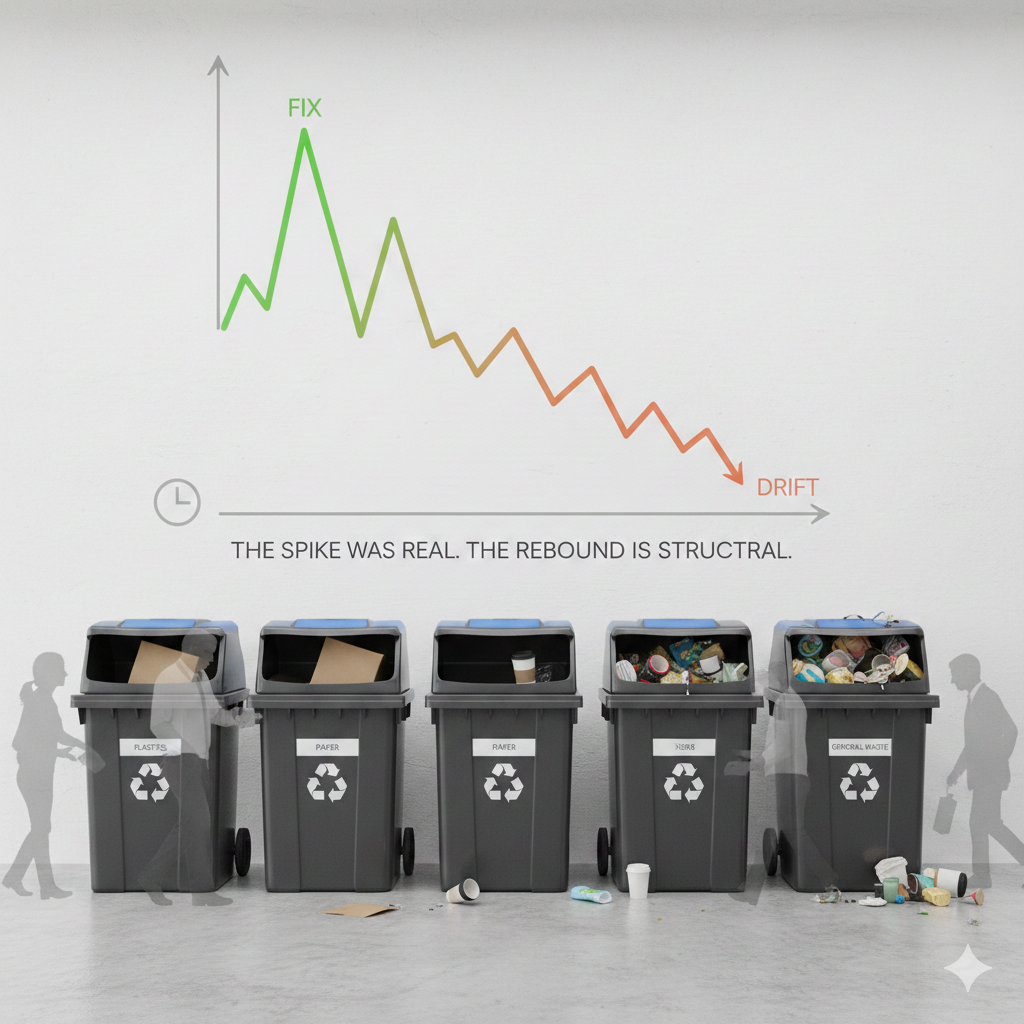
Fixes create spikes. Systems determine baselines.
Most contamination “fixes” are interventions. They add attention, energy, and clarity into the system for a short period of time.
Audits do this. Trainings do this. Signage refreshes do this. Even a strongly worded message can do this for a bit.
What they often don’t do is change the underlying baseline the system naturally returns to once attention fades.
When the extra focus disappears, the system drifts back toward the easiest available behavior. Not because anyone decided to ignore the rules, but because the structure that produces day-to-day decisions never changed.
The spike was real. The rebound is structural.
Time lag hides cause and effect.
One of the most misunderstood dynamics in waste systems is delay.
The decision that causes contamination happens in seconds. The consequence might not be visible for days or weeks, and often shows up far away from the person who made the decision.
That time lag breaks learning.
People don’t adjust behavior based on outcomes they never see. When there’s no immediate signal connecting action to consequence, the brain assumes the action was acceptable.
So even after contamination is “fixed,” the system continues generating small errors that nobody notices until they accumulate again.
Responsibility is spread thin on purpose.
In most facilities, waste decisions are shared across many people, roles, and shifts. That’s not a flaw. It’s reality.
But shared responsibility without clear ownership creates diffusion. When contamination rises, no single person feels directly responsible for noticing it early or responding to it quickly.
Everyone is doing their part. No one is watching the whole loop.
This is why contamination often comes back quietly. There’s no dramatic failure point. Just a slow erosion that doesn’t trigger action until it’s already obvious.
Systems drift under real operating pressure.
Even well-designed programs are exposed to constant pressure. Staffing changes. Seasonal volume spikes. Event days. Vendor changes. Packaging changes. Layout changes.
Each one introduces small variations. Individually, they seem harmless. Collectively, they push the system away from the conditions under which the “fix” worked.
Unless the system is designed to absorb that drift and correct for it, contamination returns without anyone making a conscious choice to let it happen.
This isn’t about discipline or vigilance.
When contamination comes back, the instinct is often to double down. More reminders. Another training. Tighter rules.
That response assumes the issue is attention or discipline. In reality, attention is already being used elsewhere. People are busy doing their jobs.
What’s missing is not effort. It’s feedback, visibility, and adjustment at the system level.
Contamination doesn’t usually return because people stop trying. It returns because the system stops teaching.
A gentle diagnostic question.
If contamination has rebounded after a successful fix, it’s worth asking:
When things start to slip, how quickly does the system notice, and who is equipped to respond before it becomes a bigger problem?
If the answer is “we find out later,” or “when it’s already bad,” that’s not a failure. It’s an explanation.