Audits are one of the most common tools used to improve waste performance. They bring attention, data, and a sense of accountability. They often work, at least at first.
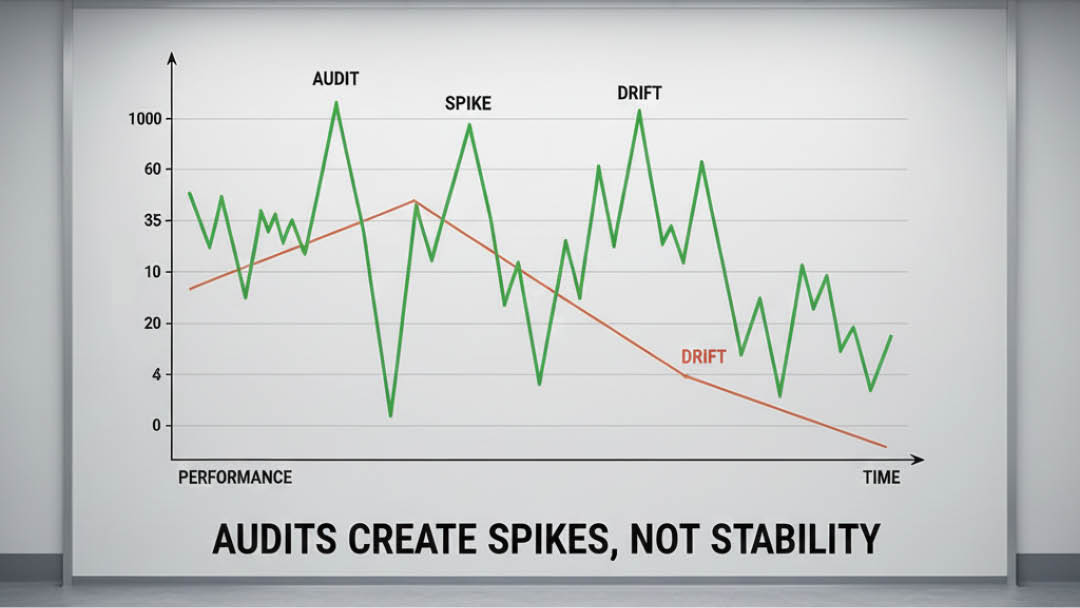
Right after an audit, contamination drops. Sorting improves. People are more careful. The system looks healthier.
Then time passes. Performance softens. The numbers creep back toward where they were before. Another audit gets scheduled, and the cycle repeats.
This pattern can feel discouraging, especially for teams putting real effort into doing things right. But it’s not a sign that audits are useless. It’s a sign of what audits are actually designed to do.
Audits measure. They don’t operate.
An audit is a snapshot. It captures what’s happening at a specific moment, often under heightened awareness.
When people know they’re being observed, behavior tightens. Decisions slow down. Edge cases get more attention. That’s human, and it’s not dishonest. It’s how attention works.
But once the audit ends, the system goes back to operating mode. Decisions speed up again. Cognitive load returns. The environment resumes shaping behavior more than memory does.
The audit didn’t fail. It just stopped being present.
Visibility without continuity fades quickly.
Audits create clarity. They surface patterns, highlight problem areas, and often validate what teams already suspect.
What they rarely provide is continuous feedback.
Between audits, most systems go quiet. There’s no regular signal telling people how they’re doing, where things are drifting, or which changes are having an effect. In that silence, behavior defaults to habit.
When the next audit arrives, it often feels like starting over, even if the underlying issues never really changed.
Spikes are a natural response to attention.
The improvement after an audit is real. It’s also temporary by design.
Audits concentrate attention. Stability requires distributed reinforcement.
Without something in the system that keeps outcomes visible and adjustments small and frequent, performance rises sharply when attention peaks, then slowly decays when attention moves elsewhere.
This isn’t a discipline issue. It’s a structural one.
Audits don’t own the loop.
One reason audits struggle to create lasting change is that they often sit outside daily operations.
The people conducting them aren’t always the people making day-to-day decisions. The findings get reported, discussed, maybe acted on once, and then archived.
There’s no closed loop connecting observation, correction, and confirmation over time. Without that loop, learning stalls.
The system gets evaluated, not trained.
More audits won’t fix what continuity would.
When performance slips, the instinct is often to audit more frequently or more aggressively.
That can increase the size of the spike, but it doesn’t change the baseline the system returns to when attention fades again.
Stability comes from systems that quietly reinforce correct behavior every day, not from periodic bursts of scrutiny.
Audits are valuable. They just aren’t meant to carry the whole load.
A gentle diagnostic question.
If audits are producing short-term improvements but long-term frustration, it’s worth asking:
What happens in the weeks between audits that helps the system notice drift and adjust before the next spike is needed?
If the answer is “not much,” that’s not a criticism. It’s a design insight.